
Dynamic Weather Factor
Every voyage estimate carries a sea margin: the allowance added to calm-water speed or consumption to cover weather and current. In most estimating tools it is a single fixed percentage, applied to every route, every month and every speed.
The weather is not fixed. A North Atlantic crossing in October and the same crossing in May are different voyages. A northern great-circle track and a southern track on the same day meet different seas. Slowing down changes how long the vessel is exposed. A margin that ignores all of this is a guess dressed as a number.
From today, the Voyage Planner in the Optimum Voyage portal replaces the fixed guess with a calculated one.
What it does
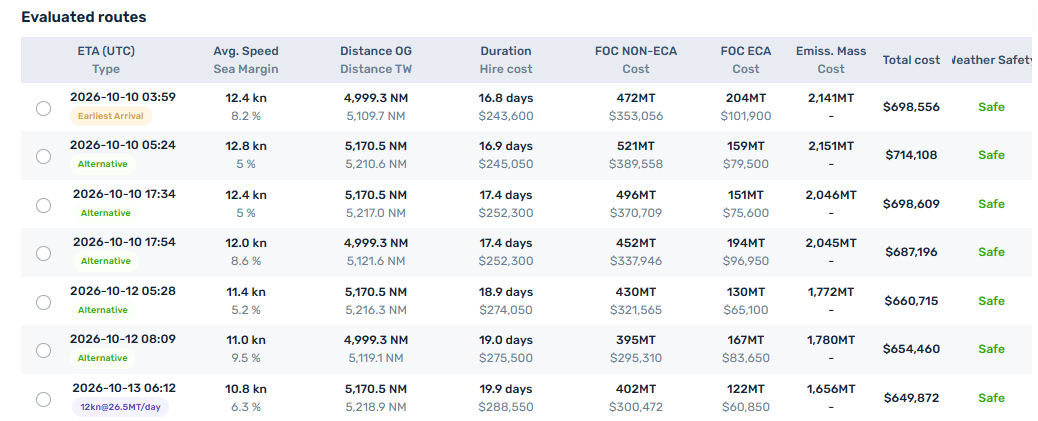
For any voyage, at any time of year, the planner now shows the sea margin for each evaluated route and speed profile, derived from the weather and current conditions recorded along that track in the same season over the last ten years. The analysis runs on more than 40 terabytes of historical weather data and is specific to the vessel's own performance model.
The result appears as a column in the route evaluation, next to speed, duration, consumption and cost, so the margin behind every estimate is visible rather than assumed.
Why it matters upstream
The sea margin decides whether a voyage looks profitable before it is fixed. Set it too low and the estimate promises a speed and consumption the vessel cannot deliver; set it too high and a good voyage is passed over for one that was never better.
In one October evaluation from Amsterdam to Houston on a product tanker, the eleven routes considered carried sea margins from 5.0% to 11.4%. The shorter northern tracks needed roughly twice the allowance of the longer southern ones, which is exactly the trade-off a fixed percentage cannot show. Two estimates built on the same fixed margin would have ranked those routes wrongly.
How to use it
Open a new voyage in the Voyage Planner, add the legs and the vessel condition, and run the route evaluation. Each option shows its own sea margin. Selecting a route carries that margin into the voyage plan, where costs and ETAs can be refined at any time. The full walkthrough is on the feature page.
The feature is available now to all managed-service clients in the portal at no additional cost.
If you want to see it on one of your own upcoming voyages, write to operations@optimumvoyage.ai with the ports and the intended departure window and we will run the evaluation for you.